Growtopia profit guide
Compare farming, mass production, providers and reselling by cost, time and realistic returns in World Locks (WL).
In this guide
Choose a profit method
No method is always the most profitable. Compare the same budget, available time and selling assumptions.
- Farming
- Grow seeds, then sell the harvest or break it for seeds and other returns. Count seeds kept for replanting separately from seeds sold. Calculate a farming batch
- Mass production (massing)
- Make a product in batches by splicing or combining ingredients. Compare buying the final ingredients with making supported ingredients yourself. Plan a production batch
- Providers
- Collect outputs over repeated cycles. Compare profit per collection with the cost of the providers and the time needed to recover that cost. Check provider payback
- Reselling
- Buy an item and sell it for more. Compare actual buyer offers with your purchase cost; another seller's asking price does not establish demand. Compare resale costs
A large estimated return is less useful if you cannot buy the ingredients or find enough buyers for the output.
Use Profit Hub for selected farming, massing, combining and provider plans, and Flip Finder for resale comparisons. Check each item's price history and listings before spending. Tradetopia covers selected recipes, not every item or profit method in Growtopia.
Calculate farming and mass production profit
Estimated operating profit = expected sale proceeds − consumed ingredient value − running costs. Ingredients you already own still have value. Reusable equipment is a separate investment; include new setup purchases when deciding how much cash you need and whether the first batch pays for itself.
-
Set a budget and method
Open Profit Hub, enter Available budget (WL) and choose a method under How do you want to earn? For massing, select Research mass projects, then compare starting points and whether to sell harvested items or seeds after breaking.
-
Check the supplies and yields
Review ingredient quantities, owned supplies, gear and seed reserves. Growth time and hands-on work are different costs. Where yields are uncertain, use your own measurements and read the lower estimate. Missing prices are not zero costs.
-
Check what can sell
Read the source offers behind output prices. Reduce the portion you expect to sell when quantities or demand are uncertain. Keep gems separate unless you enter a gems-per-WL rate you can actually achieve; an unknown gem yield is not guaranteed income.
Example: a batch with 40 WL of costs
These are hypothetical quantities and prices, not a recipe forecast. Suppose consumed ingredients cost 30 WL, running costs are 10 WL and you can sell 100 output items.
If only 60 items sell at that price, proceeds are 30 WL: 10 WL less than the batch costs, with 40 items still in inventory. If you also buy 20 WL of reusable equipment, the first batch needs 60 WL of proceeds to recover that new setup and its 40 WL costs. The equipment remains yours; its retained value is separate from cash received.
Compare provider profit and payback
In Profit Hub, choose Collect from providers. Read returns per collection alongside the collection interval and setup value. Owning a provider reduces new cash spending, but does not make the asset free when comparing returns.
Simple payback = new setup cost ÷ positive profit per collection. For example, 100 WL of new setup returning 5 WL after running costs per collection would take 20 collections to recover, assuming all planned sales happen. This is a hypothetical example; missed collections, lower selling prices and unsold stock extend payback. Zero or negative operating profit gives no payback under those assumptions.
Calculate profit from reselling items
Example: buying and selling Tea Sets
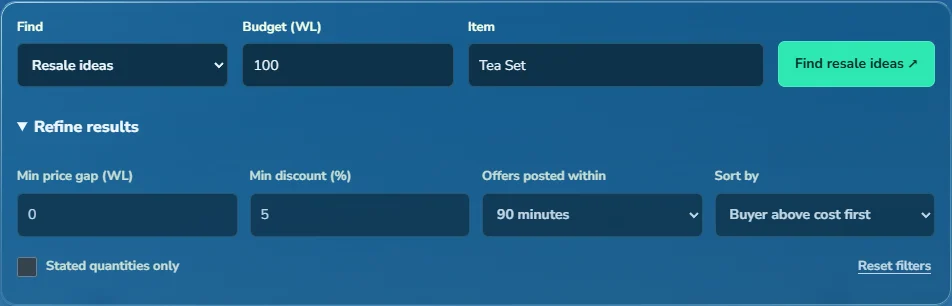
Suppose you buy 10 Tea Sets at 3 WL each and sell them for 5 WL each. These are example prices, not current offers.
-
Confirm the purchase price
Use Flip Finder to find listings within your budget, then read the original post. In this example, the seller needs to confirm that ten Tea Sets are available at 3 WL each.
-
Find a buyer
Open Tea Set and check recent WTB listings and price history. A seller asking 5 WL doesn't mean a buyer will pay that price. Decide how much you'd accept and how long you're willing to wait.
-
Save the item or set an alert
Save the item to your watchlist if you want to check it later. If your plan includes price alerts, you can receive an alert when a new sell offer meets your buying price. Neither option reserves stock.
-
List the items for sale
Include the full item name, unit price, quantity and world. Ten Tea Sets at 5 WL each cost 50 WL in total. If you use Ad Manager, read its posting restrictions and update stock after each sale.
-
Record your costs and sales
Record the purchase cost, money received from buyers and any extra costs. Profit = sales received − purchase cost − extra costs. Don't count unsold stock as money received.
 View full size
Unsold items and other costs
What if you cannot sell all ten?
| What sells | WL received | Result |
|---|---|---|
| 10 at 5 WL each | 50 WL | 20 WL profit |
| 10 at 2 WL each | 20 WL | 10 WL loss |
| 5 at 5 WL each | 25 WL | 5 WL less cash than you started with; 5 Tea Sets remain |
You may be able to sell the remaining items later, but they aren't money you've received. Check current buyer offers before estimating what they're worth.
Can I estimate profit from store packs?
Open Pack profit on the Master Surgeon's Tool Bag or Galactic Goodies item page. Enter the pack quantity and purchase cost, then expand the contents to adjust sale quantities and prices. Buyer offers estimate what you might receive; seller prices can help you choose an asking price. Items that don't fill a whole sale lot remain in inventory, and missing prices make the total incomplete. For a gem purchase, enter your own gems-per-WL rate. The calculator doesn't predict random seeds or Crime Wave cards.
Can I use this for quest supplies or farmables?
Yes. Use the same cost calculation for quest supplies, but check current buyer offers and the quest's reset time. For farming, include material costs and the time involved. Advertised prices don't predict harvest yields or guarantee a profit.
Updated 28 September 2026.
